
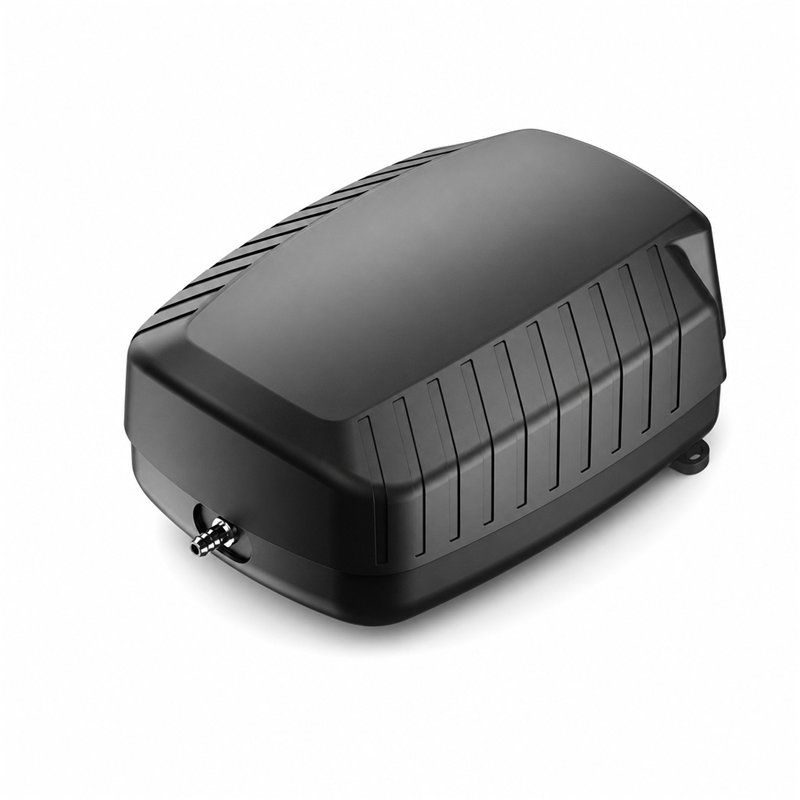
An air pump is rated by output at zero back pressure, which is not the number that matters once you connect an airstone two metres of tubing away. Output falls as soon as the pump has to push against water depth, so add roughly one pump step for every 30 cm of depth and one more if the run splits across several outlets.
Depth, not volume, is the constraint
A tall tank is harder to aerate than a long shallow one of the same volume, because the pump is pushing against a column of water rather than filling a space. Two tanks that hold the same litres can need different pump sizes purely on depth.
This is why the quoted litres-per-hour figure on a retail box is a starting point and not an answer. The figure is measured open to atmosphere; the moment the outlet sits below the surface, the working pressure changes and the delivered volume drops.
One pump and a manifold, or one pump per tank
For a fish room, run one larger pump with a manifold rather than a pump per tank. It is cheaper per outlet, and a manifold with individual valves lets you isolate a tank without shutting down the row. Keep the pump above the water line and above the highest outlet.
- One large pump plus a manifold — lower cost per outlet, single service point, one spare diaphragm kit covers the room.
- One pump per tank — no single point of failure, but more units to fail and more noise distributed around the room.
Diaphragm or electromagnetic
Diaphragm pumps are the quietest for a single tank; electromagnetic pumps last longer under continuous load and are the sensible choice for a wall of tanks or a pond. Budget for diaphragm and valve kits either way — they are wear parts, not faults.
For a private-label range this is the split worth carrying in both lines: diaphragm units for the retail shelf, electromagnetic units for the installer and the pond trade. They sell to different buyers and rarely cannibalise each other.