
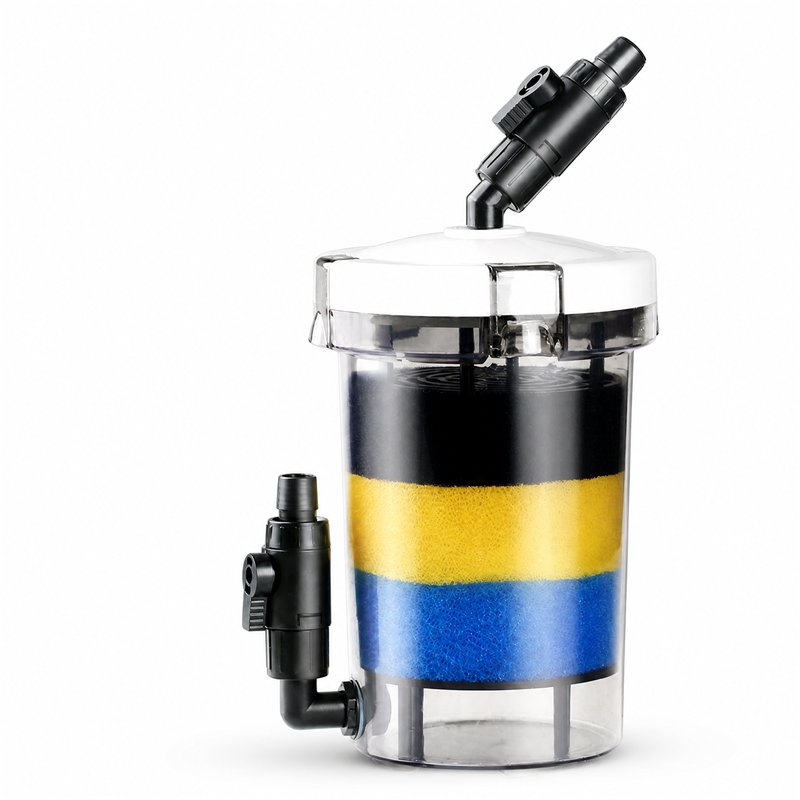
The deciding number is media volume, not flow rate. A filter that turns the tank over quickly but holds almost no media will keep the water clear and still leave the nitrogen cycle with nowhere to live, so compare models on litres of media first and litres per hour second.
Why flow rate gets quoted first
Flow rate is the easy number to print on a box and the easy number for a buyer to compare, which is why the category leads with it. It answers a real question — how quickly the water is turned over — but it says nothing about how much surface area the bacteria have to occupy.
A useful sanity check when you are specifying a range: divide the media volume by the tank volume. Two filters with the same quoted output can differ by a factor of three on that ratio, and the one holding more media is the one that will still be stable when the customer overstocks the tank.
Match the body to the tank, and to who services it
The second deciding factor is who services it. Canisters suit tanks from roughly 90 cm upward and keep equipment out of the display, at the cost of a priming routine and a place to put the body. Internal filters win below 60 cm, where a canister is disproportionate to the tank and a hang-on unit blocks the lid.
Between those two marks the choice is a service decision rather than a technical one. A hang-on unit is cleaned in minutes without disconnecting anything; a canister is cleaned properly or not at all. Whichever the end customer will actually do is the better filter.
Where the range split usually falls
For a retail range the split usually falls at the 60–90 cm band, and the question to settle with the buyer is not which is better but which one their customer will actually clean.
- Below 60 cm — internal filter, small footprint, weekly rinse of the sponge.
- 60–90 cm — hang-on if the lid has to stay closed and space is tight, canister if the tank is open or the cabinet has room.
- Above 90 cm — canister, sized on media volume, with the turnover rate treated as a secondary check.